When disfigured soldiers returned from the First World War, the authorities wanted to reintegrate them into society once they recovered from their wounds or received prosthetics. At the same time, the first attempts were made to understand the psychological damage suffered by combatants (see Pat Barker’s remarkable novel Regeneration).
The same cannot be said about survivors of amputation during Sierra Leone’s civil war (1991-2002). Many are in remote camps, increasing their sense of isolation. Although some homes were provided by international charities, supplies of food stopped after three months. For many amputees, previous trades and sources of income became impossible – try buttoning your shirt or dress with one hand – it isn’t easy. Those survivors who were mobile travelled to the capital, Freetown, to beg in the streets.
During Sierra Leone’s conflict, civilians were deliberately punished by combatants as a warning to their communities. Often, victims would return home with a sign around their necks announcing “We are sending you as our messenger.” It was standard practice for a boy-soldier to be given drugs or alcohol and then ordered to cut off the hand, arm or foot of a villager. This meant that the boy could not return to his home without fearing reprisals.
After the war, there was a truth and reconciliation commission, but it was impossible to establish how many people had suffered amputation because so many had died in the bush as a result. The estimates range from 10,000 to 27,000 (a UN figure).
What is Network for Africa doing about this?
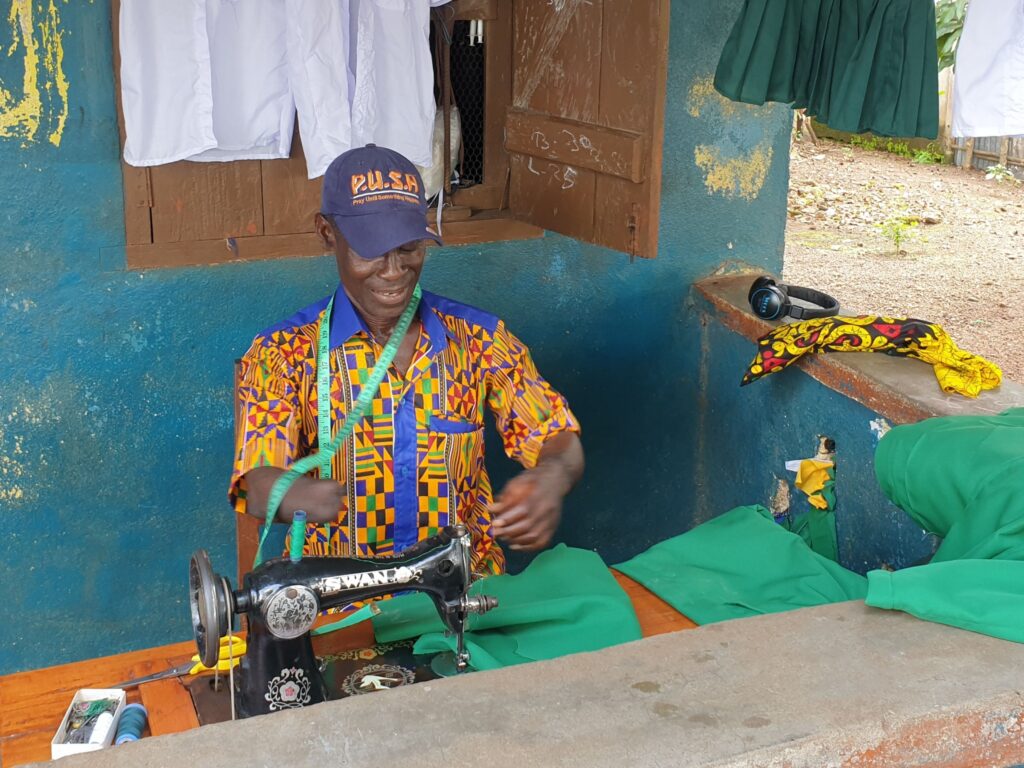
Our local partner in Sierra Leone is Network for Salone. They provide a lifeline for survivors, with training, practical help and psychological support. Recently, Tom Doughty from Network for Africa visited the project and talked to Sulaiman who was a tailor before the civil war. During the conflict, the rebels amputated his right hand. He told Tom his biggest challenge has been adapting to daily life:
“I felt so helpless. Most of the activities that I used to do, I thought I’d never be able to do again. Farming, tailoring…”
After the war, Sulaiman lived in an IDP (internally displaced persons) camp, where he met another tailor and began practising sewing with his left hand. An international charity gave him a sewing machine, and he began encouraging other amputees in the camp to learn sewing.
Sulaiman first met our local partner, Network for Salone, after the Ebola epidemic:
“Network for Salone told us, ‘All is not lost’, and helped us learn to accept our situation. They provided us with support and counselling. Previously, most people had rejected us, but [Network for Salone] stayed with us. They helped me to move forward.”
Because of his participation in the Network for Salone self-help group and its savings activities, Sulaiman can buy materials and build his tailoring business. Although he continues to work hard to support his family, he still faces many practical and emotional challenges:
“I still struggle with many things that I used to be able to do in 2 or 3 minutes.”
However, thanks to Network for Salone, the amputees need no longer beg in the streets to survive.
Thank you for helping us to provide a future for Sulaiman and the other amputees at the project. To continue supporting us please click here. Thank you.
EXTRA: This may not be for everyone – please feel free to stop reading at this point – but here is a brief history of amputation as a punishment.
It is first mentioned in 1,700 BC as a codified legal penalty in ancient Babylon. It was also enshrined in law in China, India, and Peru in past centuries, and it remains on the books in countries ruled by shariah law (Afghanistan, Saudi Arabia, Iran, Sudan, Yemen). It was widely used during the Atlantic and Arab slave trades, and by the Spanish conquistadors in the new world.
More recently, Belgian colonialists amputated the hands of rubber plantation workers in the Congo and Rwanda if they did not meet their quota (see Adam Hochschild’s book King Leopold’s Ghost). It occurred in Mozambique’s vicious civil war, during the Cold War; and in northern Uganda (where Network for Africa also works), the Lord’s Resistance Army used amputation of ears, lips and hands to terrify locals into silence and obedience. During the Vietnam war, it was alleged that soldiers collected the ears of the Viet Cong.
In other words, this is not a uniquely African practice. Rather, it is one of the many horrible things humans do to each other. Happily, there are also people such as our partners in Sierra Leone doing noble and decent things to redress the balance. Please click here to donate to support our work. Thank you.
Rebecca Tinsley
Founder, Network for Africa